Project support

Electro-Voice Services for audio systems that have to work on opening night

Support starts with the room: audience geometry, throw distance, rigging path, stage volume, low-frequency control, and how the system will be operated after handoff.

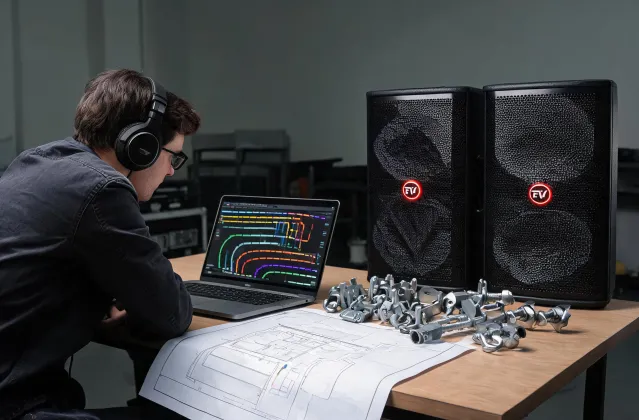
Audio engineer reviewing loudspeaker coverage model
01

Coverage planning before product selection

Electro-Voice project conversations begin with coverage rather than a fixed shopping list. A compact club, a reverberant worship room, and a corporate auditorium each ask for different directivity, fill strategy, and subwoofer placement. The service workflow captures seating maps, throw distance, ceiling height, trim limits, expected program material, and whether the system will be moved, flown, bracketed, or stored between events. That information helps narrow loudspeaker families quickly without guessing from wattage alone.

02

Rigging and installation coordination

When line array systems or installed loudspeakers need to meet a building, the support path includes mounting context, hardware selection, aiming targets, and service access. Installers can clarify where cable paths, balcony edges, architectural finishes, and sightlines affect the final design. Touring crews can also use the same brief to define ground-stacked alternatives, truck-pack limits, and quick-change monitor positions for repeatable show days.

03

DSP alignment and commissioning notes

System behavior is not finished when the boxes are mounted. The service brief can document crossover expectations, delay relationships, front-fill timing, speech reinforcement needs, and low-frequency pattern goals. That gives engineers a shared language for the first tuning pass, the handoff file, and any later expansion. For dealer-supported projects, it also keeps the conversation grounded in measurable audio outcomes rather than vague loudness requests.

It is also where honest limits get written down. A waveguide's coverage angle is fixed by the enclosure, so seats outside the pattern need fills rather than more gain; continuous level is bounded by thermal headroom on long programs; and a room's reverberation, not the speaker alone, often sets the real intelligibility ceiling. Naming those constraints in commissioning notes keeps expectations and measurements aligned.

04

Dealer routing for purchase and support

Professional audio decisions often move through regional dealers, integrators, and production partners. A structured Electro-Voice inquiry makes that handoff cleaner by naming the product categories, venue type, schedule, and support question in one place. The result is a better first conversation about availability, alternatives, accessories, training needs, and how the system will be supported after the first event.

Bring the room details into the first Electro-Voice conversation

Send the system brief, expected audience size, source count, and mounting constraints so the next step can focus on coverage and deployment instead of generic product sorting.

Request Service Support