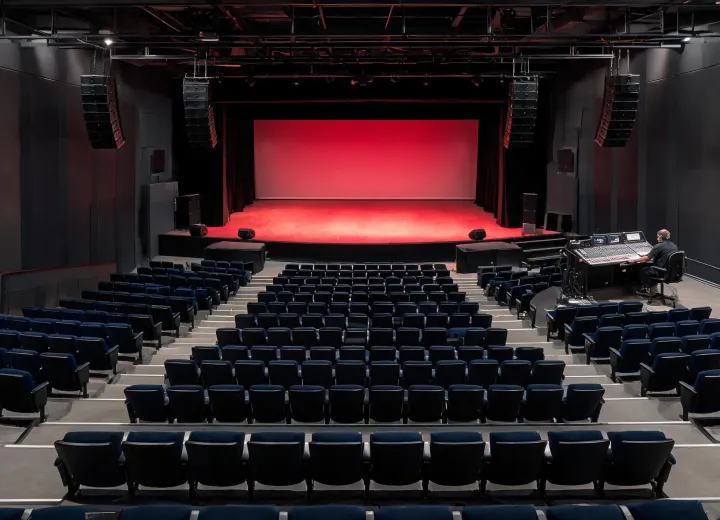
Every system note starts with where people sit, stand, perform, listen, and move.
The brand story on this site is written for the people who specify, deploy, tune, and maintain audio systems. It treats loudspeaker design as a practical chain from transducer behavior to the last occupied seat.
Professional audio brands earn trust when engineers can hear the same decision twice: first in the design room, then in the venue. Electro-Voice keeps that practical lens. A loudspeaker is never described as an isolated box. It belongs to an array hang, a portable PA stack, a worship mix, a theatre balcony, a presenter microphone chain, or a stage monitor lane where performers need clarity without fighting feedback.
The operating idea is simple but demanding. Every product category must help a buyer explain why it belongs in the system. Loudspeakers carry vocal articulation and music detail. PA speakers need fast setup and reliable level. Subwoofers should extend the program without swallowing speech. Line array systems must keep coverage predictable across rows. Stage monitors have to serve performers while leaving the front-of-house mix cleaner.
That discipline shows in how a brief is built. A worship-room design, for example, moves through a fixed chain: balcony seating map, throw distance and ceiling trim, speech gain before feedback, music headroom, then volunteer-friendly presets. Five product families covering loudspeakers, PA speakers, subwoofers, line arrays, and stage monitors are matched against that chain rather than picked from a wattage column, so the same reasoning is repeatable from one room to the next.
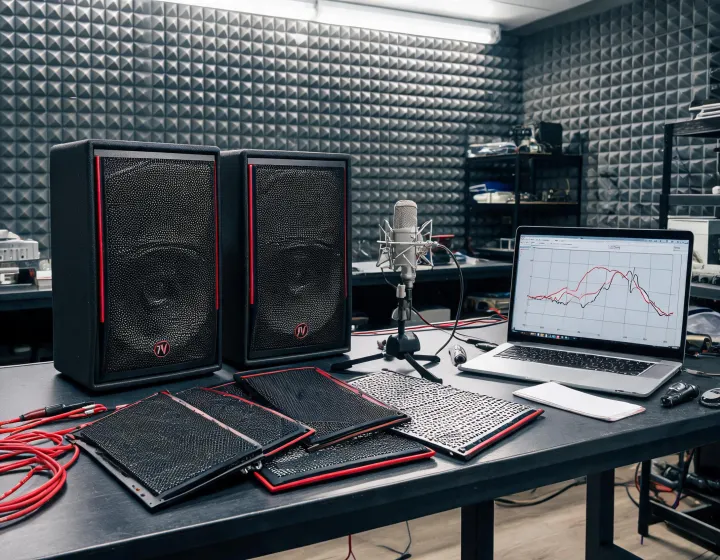
Useful innovation is not a louder claim. It is a cleaner path from acoustic intent to the crew member who has to make the show happen.
Every system note starts with where people sit, stand, perform, listen, and move.
Speech intelligibility, vocal focus, and musical detail stay visible in the design brief.
Hardware, cabling, transport, and service access are treated as audio decisions, not afterthoughts.
Dealer routing, commissioning notes, and expansion paths help teams protect the system after launch.
In practice those values map onto measurable parameters, not adjectives: horizontal and vertical dispersion angle, continuous versus peak SPL with thermal headroom, low-frequency tuning and alignment (sealed or ported), rigging and trim limits, and crossover or delay relationships between mains, fills, subs, and monitors. Stating each product family in those terms is what keeps an Electro-Voice brief verifiable rather than promotional.
Integrators and production teams use different vocabulary, but they share a common risk: the audience only experiences the final system. That is why the Electro-Voice page set emphasizes application language. A cinema retrofit needs low-frequency confidence and screen-channel clarity. A house of worship needs spoken word gain before feedback and natural music reinforcement. A touring package needs predictable rigging, quick recall, and monitor lanes that artists can trust.
This approach also keeps content useful for procurement teams. Instead of presenting generic claims, the site names the decisions buyers actually make: system category, output requirement, mounting method, schedule, dealer support, and commissioning expectations. The result is a quieter, more technical way to start an audio conversation.
It also means being candid about limits. A single loudspeaker family does not solve every room: coverage angle is set by the box, continuous output is bounded by thermal headroom, and an outdoor stage loses the reflective reinforcement an enclosed hall provides. Stating those boundaries early is part of how Electro-Voice content earns engineering trust rather than spending it on overclaims.
Tell us whether the project is a fixed install, tour package, portable PA kit, or upgrade path. The same short brief can support dealer routing and early system matching.